Foot complaints and insoles

There are many different kinds of complaints. Some are located directly in the feet, but poor foot alignment often causes problems elsewhere in your body too. Your feet are the foundation of your body for a reason.

Every foot is different. During the consultation we examine your complaint and discuss whether an insole or orthosis makes sense for you.

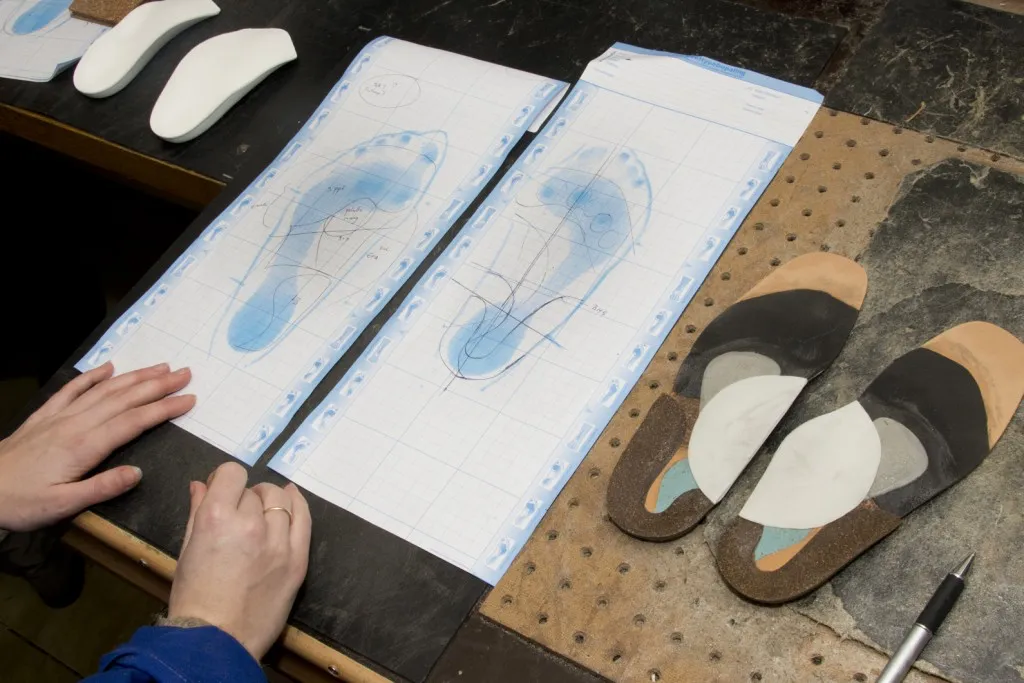
Foot imprint and handmade podiatric insoles in the workshop

Heel and Achilles tendon

Pain under or behind the heel is one of the most common reasons to visit a podiatrist.

Plantar fasciitis (heel spur)

Stabbing pain under the heel or in the arch, especially with the first steps in the morning. Caused by overloading the tendon plate under the foot.

How an insole helps: An insole supports the arch, unloads the plantar fascia and cushions the heel so the painful area can recover. [1][2][3]

More about Heel spur (plantar fasciitis)

Heel pain and bruised heel

Pain in the fat pad of the heel, for example from a lot of standing, hard surfaces or a thin fat pad.

How an insole helps: A heel cup and extra cushioning in the insole spread the pressure and protect the fat pad.

Achilles tendon complaints

Pain and stiffness in the tendon behind the ankle, common in runners and people who walk a lot.

How an insole helps: A small heel raise and correction of the foot position reduce the pull on the Achilles tendon. [4]

More about Achilles tendon pain

Haglund's deformity (heel bump)

A hard, often painful bump at the back of the heel that rubs against the shoe.

How an insole helps: An adapted insole and heel height change the contact point with the shoe, so the bump is irritated less.

Heel pain in children (Sever's disease)

Pain at the back of the heel in growing, active children, caused by overloading the growth plate.

How an insole helps: Children's insoles with a heel raise and cushioning unload the growth plate so your child can keep moving. [5]

More about Children’s feet

Bursitis behind the heel

A painful, sometimes swollen spot between the heel bone and Achilles tendon, often together with a heel bump and pressing shoes.

How an insole helps: A slight heel raise and an insole that keeps the heel stable reduce pressure and friction on the bursa.

Foot posture and arch

An abnormal foot posture affects the whole body. This is the core of what an insole does.

Flat foot and fallen arches

The arch collapses (too far), turning the foot, ankle and knee inwards. Can cause tired feet and pain.

How an insole helps: An insole supports the arch and straightens the heel so the load is distributed properly over the foot again. [6]

More about Flat feet

High arch (pes cavus)

A high, rigid arch that puts most of the pressure on the heel and the ball of the foot.

How an insole helps: An insole that fills the arch increases the contact area and spreads the pressure more evenly. [7][1]

More about High arches

Splay foot

The forefoot widens because the transverse arch collapses, often with calluses and pain under the ball of the foot.

How an insole helps: A metatarsal pad behind the ball of the foot supports the transverse arch and unloads the metatarsal heads. [8]

More about Forefoot pain

Overpronation (rolling inwards)

The foot rolls inwards too much when walking or running, which can lead to knee, shin and hip complaints.

How an insole helps: A correction on the inside of the insole slows the rolling and stabilises the foot with every step.

Supination (rolling outwards)

The foot lands and stays too much on its outer edge, increasing the risk of sprains and shock loading.

How an insole helps: A correction on the outside and extra cushioning provide a more stable and softer roll-off.

Leg length difference

A difference in leg length can lead to a tilted pelvis and hip and back complaints.

How an insole helps: A raise in or under the insole compensates for the difference so the pelvis is level again.

Posterior tibial tendon dysfunction (adult acquired flat foot)

Pain on the inside of the ankle and arch, with the arch gradually collapsing further. Mostly seen in adults over 40.

How an insole helps: A firm insole supporting the arch and heel unloads the tendon; combined with exercises this gives the best results. [9]

Bow legs and knock knees

An abnormal leg axis puts extra load on the inside or outside of the knee and foot and can cause knee, ankle and foot complaints.

How an insole helps: An insole with a targeted correction can distribute the load on the knee and foot better; the effect varies from person to person. [10]

Hypermobility (overly flexible joints)

Very flexible joints and ligaments, so the foot collapses far under load and quickly becomes tired or painful.

How an insole helps: A supportive insole gives the foot the stability the ligaments lack, so muscles and joints have to work less hard.

Forefoot and toes

Pressure points and forefoot pain can often be relieved well with an insole or a silicone orthosis.

Forefoot pain (metatarsalgia)

Burning or stabbing pain under the ball of the foot, often from too much pressure on the metatarsal heads.

How an insole helps: A metatarsal pad and soft padding move the pressure away from the painful area. [8]

More about Forefoot pain

Morton's neuroma

Tingling, numbness or shooting pain between the third and fourth toe caused by an irritated nerve.

How an insole helps: A metatarsal pad spreads the metatarsal bones slightly so the nerve is pinched less. [11]

More about Morton's neuroma

Hallux valgus (bunion)

The big toe angles towards the other toes, with a painful bump on the inside of the foot.

How an insole helps: An insole improves the roll-off and unloads the joint; a silicone orthosis protects the bump and the toes. [12][8][1]

More about Hallux valgus

Stiff big toe and arthritis (hallux limitus / rigidus)

A stiff and painful big toe joint, especially when pushing off while walking.

How an insole helps: An insole with a stiffened roll-off limits bending of the joint and so reduces the pain. [13]

Bump on the outside (tailor's bunion)

A bump near the little toe that rubs and presses inside the shoe.

How an insole helps: An insole that stabilises the forefoot and an orthosis that protects the bump reduce the rubbing.

Sesamoiditis

Pain under the ball of the big toe from overloading the small sesamoid bones, common in dancers and runners.

How an insole helps: A cut-out or soft padding under the sesamoids takes the pressure off the painful spot.

Hammer toes and claw toes

Bent toes that press on top or at the tip, causing corns and pain.

How an insole helps: A custom silicone orthosis improves the toe position and protects pressure points; an insole can unload the forefoot.

Overlapping toes

Toes that slide over or under each other and therefore press and rub.

How an insole helps: A silicone orthosis between the toes keeps them in place and prevents pressure pain.

Calluses and corns

Calluses and corns result from too much pressure or friction in one spot.

How an insole helps: By distributing pressure better, an insole or orthosis tackles the cause, so calluses and corns come back less.

Metatarsal stress fracture

A hairline crack in a metatarsal bone from repeated overloading, for example from running or a lot of walking. Have it diagnosed by a doctor first.

How an insole helps: After healing, an insole that unloads the forefoot and spreads the load can help prevent a new stress fracture. [14]

Freiberg disease (Köhler II)

Pain and swelling under the ball of the foot, usually at the second metatarsal, mainly in girls and young women.

How an insole helps: A metatarsal pad and cut-out under the painful head unload the joint so it can recover.

Ledderhose disease (lumps in the sole)

Hard, benign lumps in the plantar fascia under the arch that can press painfully when standing and walking.

How an insole helps: An insole with a soft cut-out exactly under the lumps removes the pressure so walking becomes comfortable again.

Pressure points and blisters

Recurring red spots or blisters in the same place, caused by friction or too much pressure in the shoe.

How an insole helps: An insole that keeps the foot stable in the shoe and spreads pressure, or an orthosis on the pressure point, prevents new blisters.

Midfoot and outer foot

Complaints in the middle or on the outside of the foot often relate to an unstable foot or poor roll-off.

Midfoot osteoarthritis

Pain and stiffness on top of the foot or in the arch, sometimes with a bony bump, especially when walking and climbing stairs.

How an insole helps: An insole that supports the arch and stabilises the midfoot reduces movement in the painful joints.

Sinus tarsi syndrome

Pain on the outside of the foot just in front of the ankle, often after a sprain or with a foot that rolls inwards strongly.

How an insole helps: An insole that straightens the heel bone and limits overpronation reduces the pinching in the sinus tarsi.

Cuboid syndrome (outer foot pain)

Pain along the outer edge of the foot at the cuboid bone, often in athletes or after a sprain.

How an insole helps: A small support under the cuboid in the insole supports the bone and reduces pain during roll-off.

Tendon pain on the outside (peroneal tendons)

Pain behind and below the outer ankle, often with a high arch or a foot that rolls outwards.

How an insole helps: An insole with a lateral correction and good cushioning unloads the tendons and gives the ankle more stability.

Köhler disease (children)

Pain and swelling on the inside of the midfoot in young children, caused by a temporarily disturbed blood supply to the navicular bone.

How an insole helps: A supportive children’s insole unloads the bone during recovery so your child can walk and play with less pain.

More about Children’s feet

Ankle

An unstable or overloaded ankle benefits from a well-guiding insole.

Unstable ankle and frequent sprains

After a sprain the ankle sometimes stays unstable, so you keep going over on it.

How an insole helps: An insole with a lateral correction gives the ankle more stability; medical taping can provide extra support.

Ankle wear (osteoarthritis)

Pain and stiffness in the ankle under load due to wear of the joint.

How an insole helps: Cushioning and a stable foot position reduce the shocks and twisting forces on the joint.

Tarsal tunnel syndrome

Numbness, tingling and radiating pain on the inside of the ankle and sole caused by a trapped nerve.

How an insole helps: If fallen arches put extra strain on the nerve, an insole that supports the arch can reduce the pressure.

Lower leg and knee

Many knee and shin complaints start at the feet: a poor foot position twists the whole leg.

Shin splints

Stabbing pain along the inside of the shin when running or walking a lot.

How an insole helps: Correcting overpronation and absorbing shocks reduces the pull on the shin. [15]

More about Shin splints

Lower leg pain during exercise (compartment syndrome)

A pressing, cramping pain in the lower legs that comes on during exercise and fades with rest.

How an insole helps: A better foot position and roll-off can lower the load on the lower leg muscles; have the diagnosis confirmed by a doctor.

Tired feet and legs

Feet and legs that tire quickly or feel heavy, especially after long periods of standing or walking.

How an insole helps: A well-supporting insole means the muscles have to work less hard to keep the foot stable.

Growing pains in children

Pain in the legs or feet of growing children, often with an abnormal foot position or a lot of sport.

How an insole helps: Custom children's insoles support the growing foot; we take your child's development and sport into account.

More about Children’s feet

Runner's knee (iliotibial band syndrome)

Pain on the outside of the knee when running or cycling.

How an insole helps: Correcting the foot position reduces rotation of the lower leg and thus friction on the outside of the knee.

More about Knee pain

Pain around the kneecap (patellofemoral pain)

Aching or stabbing pain around or behind the kneecap, especially on stairs, squatting or sitting for long.

How an insole helps: If the knee turns inwards because of the foot position, an insole helps the kneecap track better. [16]

More about Knee pain

Jumper's knee

Pain just below the kneecap in jumping sports such as volleyball and basketball.

How an insole helps: Cushioning and a stable foot position reduce the impact and load on the patellar tendon when landing.

More about Knee pain

Osgood-Schlatter (bump below the knee)

A painful, hard bump below the knee in active, growing children.

How an insole helps: Children's insoles with cushioning and correction reduce the pull on the attachment of the patellar tendon.

More about Children’s feet

Pain on the inside or outside of the knee and knee osteoarthritis

Overloading of the knee ligaments or wear (gonarthrosis) caused by uneven loading of the knee.

How an insole helps: An insole with the right correction can shift the load to the less painful part of the knee and absorb shocks. [10][17]

More about Knee pain

Stress fractures and injury prevention in sport

A lot of walking, marching or running can lead to stress fractures of the shin or thigh bone and to overuse injuries.

How an insole helps: In studies, foot orthoses lowered the risk of injuries and stress fractures – simple shock-absorbing insoles did not. [14][18]

Hip and back

Your feet are the foundation of your body. A better foot position can also bring relief higher up in the body.

Lower back pain

Back complaints that get worse with prolonged standing or walking, sometimes linked to foot posture or a leg length difference.

How an insole helps: Cushioning and a straight position of the feet and pelvis reduce shocks and uneven loading of the back. [19]

Hip complaints

Pain on the side or front of the hip, for example from overloading or a tilted pelvis.

How an insole helps: Correcting the leg axis and, if needed, compensating a leg length difference loads the hip more evenly.

High-risk feet

With diabetes and rheumatism, good pressure distribution is extra important to prevent problems.

Diabetic foot and neuropathy

With diabetes, sensation in the feet can decrease so pressure points are not noticed in time.

How an insole helps: A soft, pressure-distributing insole protects vulnerable areas. Wound care belongs with a podotherapist or doctor. [20]

Rheumatoid foot

Rheumatism can cause painful, deformed joints in the forefoot and toes.

How an insole helps: Soft materials, metatarsal pads and orthoses unload the painful joints and make walking more comfortable. [21][8][1]

What we do not treat

Nail problems (ingrown toenail, fungal nail) and wound care are outside podology. For these, please see a pedicurist or podotherapist. Read more about the difference between a podologist and a podotherapist.

Questions about foot complaints

Which complaints can insoles help with?

Insoles help with complaints caused by poor alignment or loading of the feet: heel spur, Achilles tendon complaints, flat feet, high arches, splay foot, forefoot pain, Morton’s neuroma, hallux valgus, calluses and corns, as well as shin splints and knee, hip and lower back complaints. See the overview of foot complaints.

Do insoles help with heel spur (plantar fasciitis)?

Yes, it is one of the complaints we most often make insoles for. The insole supports the arch, unloads the plantar fascia and cushions the heel. Read more about plantar fasciitis.

Can I see a podiatrist for knee, hip or back complaints?

Yes. A registered podiatrist looks not only at the foot but at the entire musculoskeletal system. Knee, hip or back complaints can result from an abnormal foot position; correcting it can reduce the complaints.

Will the insoles fit my own shoes?

Our insoles are built from thin cork elements and adapted as much as possible to the shoes you like to wear: from everyday shoes and heels to sports shoes, sandals, work shoes, boots and even clogs. Where necessary we give written advice for your shoe shop.

Do you also treat nail problems or wounds?

No. Ingrown toenails, fungal nails and wound care are outside podology; for these please see a pedicurist or podotherapist. For pressure pain on or between the toes we do make a silicone orthosis.

Frequently asked questions →

Scientific evidence

How well insoles work differs per complaint. Below are the studies we refer to, with what they found in plain language – including where the evidence is limited. Insoles work best as part of a complete approach, together with exercises, suitable footwear and advice.

  1. Cochrane review: the strongest evidence for custom orthoses is for painful high-arched feet, with further evidence for foot pain in (juvenile) rheumatoid arthritis, plantar fasciitis and hallux valgus.

    Hawke F, Burns J, Radford JA, du Toit V Custom-made foot orthoses for the treatment of foot pain. Cochrane Database Syst Rev. 2008;(3):CD006801. PubMed 18646168 · doi

  2. On their own, insoles are not clearly better than sham insoles or other conservative care for heel pain – so combine them with stretching and advice.

    Rasenberg N, Riel H, Rathleff MS, et al. Efficacy of foot orthoses for the treatment of plantar heel pain: a systematic review and meta-analysis. Br J Sports Med. 2018;52:1040-1046. PubMed 29555795 · doi

  3. Guideline: start with taping, stretching and education; if recovery is insufficient, shockwave therapy and custom orthoses follow.

    Morrissey D, Cotchett M, Said J’Bari A, et al. Management of plantar heel pain: a best practice guide informed by a systematic review, expert clinical reasoning and patient values. Br J Sports Med. 2021;55:1106-1118. PubMed 33785535 · doi

  4. For mid-portion Achilles tendinopathy, custom orthoses added little to exercise therapy; insoles are mainly useful with an abnormal foot posture.

    Munteanu SE, Scott LA, Bonanno DR, et al. Effectiveness of customised foot orthoses for Achilles tendinopathy: a randomised controlled trial. Br J Sports Med. 2015;49:989-994. PubMed 25246441 · doi

  5. In Sever's disease, heel raises gave the fastest short-term relief; after 12 months all treatments were equally effective.

    James AM, Williams CM, Haines TP Effectiveness of footwear and foot orthoses for calcaneal apophysitis: a 12-month factorial randomised trial. Br J Sports Med. 2016;50:1268-1275. PubMed 26917682 · doi

  6. Most flat feet in children cause no complaints and need no treatment; when there is pain, insoles and exercises can help.

    Evans AM, Rome K A Cochrane review of the evidence for non-surgical interventions for flexible pediatric flat feet. Eur J Phys Rehabil Med. 2011;47:69-89. PubMed 21448121

  7. For painful high-arched feet, custom orthoses reduced pain and improved function clearly more than sham insoles, lowering pressure under the whole foot.

    Burns J, Crosbie J, Ouvrier R, Hunt A Effective orthotic therapy for the painful cavus foot: a randomized controlled trial. J Am Podiatr Med Assoc. 2006;96:205-211. PubMed 16707631

  8. Custom orthoses reduced forefoot pain in rheumatoid arthritis, hallux valgus and metatarsalgia by redistributing pressure under the forefoot.

    Arias-Martín I, Reina-Bueno M, Munuera-Martínez PV Effectiveness of custom-made foot orthoses for treating forefoot pain: a systematic review. Int Orthop. 2018;42:1865-1875. PubMed 29423640 · doi

  9. In early posterior tibial tendon problems, orthoses plus stretching helped; strengthening exercises improved results further.

    Kulig K, Reischl SF, Pomrantz AB, et al. Nonsurgical management of posterior tibial tendon dysfunction with orthoses and resistive exercise: a randomized controlled trial. Phys Ther. 2009;89:26-37. PubMed 19022863 · doi

  10. Custom, full-length insoles with shock absorption and arch support performed best; they improve knee alignment, while the effect on pain varies.

    Zafar AQ, Zamani R, Akrami M The effectiveness of foot orthoses in the treatment of medial knee osteoarthritis: a systematic review. Gait Posture. 2020;76:238-251. PubMed 31874456 · doi

  11. Cochrane review: most treatments, including insoles, have hardly been tested in good trials yet; insoles are a safe first step.

    Matthews BG, Thomson CE, Harding MP, et al. Treatments for Morton's neuroma. Cochrane Database Syst Rev. 2024;2:CD014687. PubMed 38334217 · doi

  12. Orthoses provide short-term symptom relief; correcting the toe position itself requires surgery.

    Torkki M, Malmivaara A, Seitsalo S, et al. Surgery vs orthosis vs watchful waiting for hallux valgus: a randomized controlled trial. JAMA. 2001;285:2474-2480. PubMed 11368700 · doi

  13. For big toe joint arthritis, insoles reduce pain as well as rocker-sole shoes, with better adherence and fewer side effects.

    Menz HB, Auhl M, Tan JM, et al. Effectiveness of foot orthoses versus rocker-sole footwear for first metatarsophalangeal joint osteoarthritis: randomized trial. Arthritis Care Res (Hoboken). 2016;68:581-589. PubMed 26638878 · doi

  14. Foot orthoses reduced the risk of injuries and stress fractures; simple shock-absorbing insoles did not.

    Bonanno DR, Landorf KB, Munteanu SE, et al. Effectiveness of foot orthoses and shock-absorbing insoles for the prevention of injury: a systematic review and meta-analysis. Br J Sports Med. 2017;51:86-96. PubMed 27919918 · doi

  15. No treatment for shin splints is strongly proven; correcting foot posture and load advice are commonly combined in practice.

    Winters M, Eskes M, Weir A, et al. Treatment of medial tibial stress syndrome: a systematic review. Sports Med. 2013;43:1315-1333. PubMed 23979968 · doi

  16. International consensus: foot orthoses are recommended to reduce pain around the kneecap in the short term, alongside exercise therapy.

    Collins NJ, Barton CJ, van Middelkoop M, et al. 2018 Consensus statement on exercise therapy and physical interventions (orthoses, taping and manual therapy) to treat patellofemoral pain. Br J Sports Med. 2018;52:1170-1178. PubMed 29925502 · doi

  17. A simple lateral wedge insole is not better than a neutral insole for knee osteoarthritis – customisation and the right correction matter.

    Parkes MJ, Maricar N, Lunt M, et al. Lateral wedge insoles as a conservative treatment for pain in patients with medial knee osteoarthritis: a meta-analysis. JAMA. 2013;310:722-730. PubMed 23989797 · doi

  18. Insoles reduced femoral and tibial stress fractures in military recruits; in athletes this has not been studied enough.

    Snyder RA, DeAngelis JP, Koester MC, et al. Does shoe insole modification prevent stress fractures? A systematic review. HSS J. 2009;5:92-98. PubMed 19506967 · doi

  19. There is insufficient evidence that insoles prevent or treat back pain in general; they appear to help mainly where foot posture plays a role.

    Chuter V, Spink M, Searle A, Ho A The effectiveness of shoe insoles for the prevention and treatment of low back pain: a systematic review and meta-analysis of randomised controlled trials. BMC Musculoskelet Disord. 2014;15:140. PubMed 24775807 · doi

  20. International guideline: pressure-relieving footwear and custom insoles help prevent foot ulcers in people with diabetes at increased risk.

    Bus SA, Sacco ICN, Monteiro-Soares M, et al. Guidelines on the prevention of foot ulcers in persons with diabetes (IWGDF 2023 update). Diabetes Metab Res Rev. 2024;40:e3651. PubMed 37302121 · doi

  21. Foot orthoses reduce foot pain and disability in rheumatoid arthritis; long-term benefits are not yet proven.

    Lin Z, Gong C, Wang D, et al. Effect of foot orthoses on foot problems in patients with rheumatoid arthritis: a systematic review and meta-analysis of randomized controlled trials. Disabil Rehabil. 2026;48:1546-1560. PubMed 41044984 · doi
Trouble with your feet? We are happy to help.

First consultation usually within 1 week, in Oldenzaal, Denekamp or Losser.